www.bbcmirror.lk
www.Lankawebnews.lk
sustainable drinking water for every citizen within the next decade must be our strategic national objective.” – Professor Chrishantha Abeysena, Minister of Science and Technology
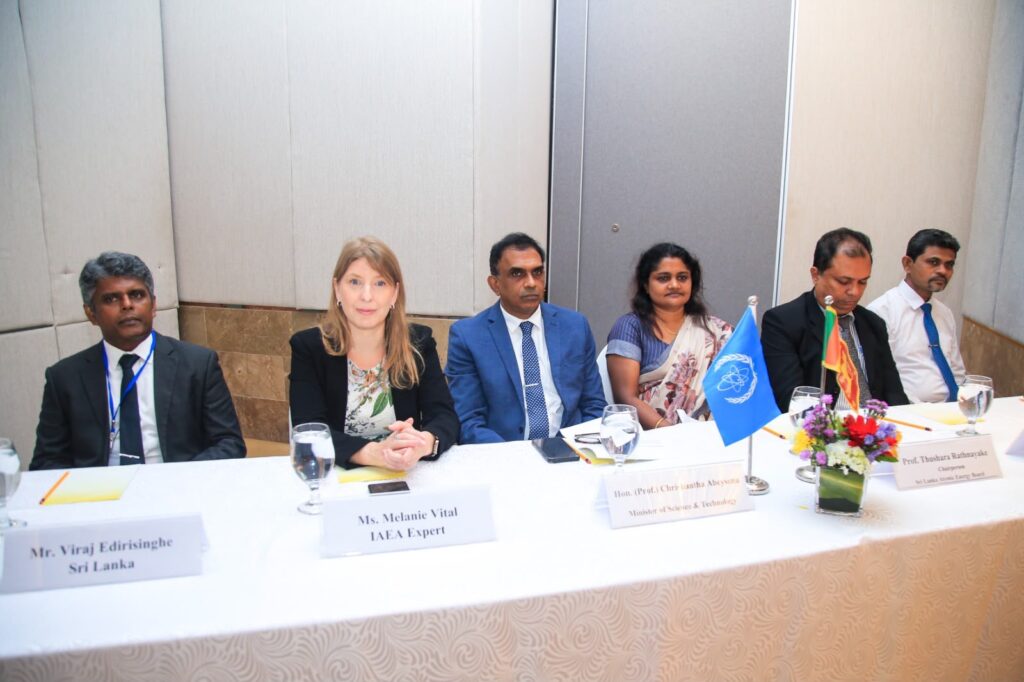
Ensuring that every citizen has access to safe, clean, and naturally sustainable drinking water within the next decade must be established as a strategic national objective, stated Professor Chrishantha Abeysena, Minister of Science and Technology. He made these remarks while attending as the chief guest at the inauguration session of the regional training course on “Evaluating the Efficacy of Artificial Recharge to Groundwater in Water Scarce Regions using Isotope Techniques (RCA),” organized by the Sri Lanka Atomic Energy Board (SLAEB) in collaboration with the International Atomic Energy Agency (IAEA). The program commenced today (20th) at the Ramada Hotel, Colombo.
This workshop is conducted under the technical cooperation projects of the International Atomic Energy Agency (IAEA). Isotope hydrology is widely utilized worldwide to understand the secrets of groundwater and serves as an effective tool for studying the efficiency of artificial groundwater recharge. The objective of this training course is to develop regional capacities in applying isotope technology within water resource management.
Bringing together prominent scholars, researchers, policymakers, and professionals from across the Asia-Pacific region, this important regional program provides a unique platform to exchange knowledge, strengthen technical capacities, and promote the use of isotope technologies for sustainable groundwater management.
Addressing the gathering, Minister Professor Chrishantha Abeysena stated:
“One of the most severe challenges we face in Sri Lanka is concentrated in our dry zone, particularly the North Central Province. For decades, our communities have been battling the devastating impacts of Chronic Kidney Disease of unknown etiology (CKDu). The severe spread of this disease is strongly linked to the quality of groundwater, which serves as the primary source of drinking water. Although ‘Reverse Osmosis’ (RO) water purification systems are widely used in these vulnerable areas, there is still no definitive understanding of the long-term health and metabolic impacts of consuming such purified water. Therefore, we cannot rely solely on RO systems as a permanent solution to this problem. Ensuring safe, clean, and naturally sustainable drinking water for every citizen within the next decade must be our strategic national objective. The knowledge exchanged in programs like this is crucial for that purpose. Across the Asia-Pacific region, we face shared climate vulnerabilities, and regional and technical cooperation is essential to solve these complex problems.”
The event was attended by Professor Thushara Rathnayake, Chairman of the Sri Lanka Atomic Energy Board; Mr. Ravi Kalupahana, Director General; along with other officials, IAEA expert Ms. Melanie Vital, representatives from IAEA member states in the Asia-Pacific region, as well as international experts, and representatives from the National Water Supply and Drainage Board and the Water Resources Board.
Nithya Silva
Media Secretary to the
Hon. Minister of Science and Technology